Alice Liptrot


Please share a bit about yourself and your background.
My name is Alice Liptrot and I’m a textile artist based on the Kent coast in England, about an hour south of London. I’ve been working full time as an artist for just over a year, but my relationship with yarn goes back much further. I studied knitwear at Brighton University and later co founded a British made knitwear brand, focused mainly on menswear, which I ran for ten years.
That experience shaped both my understanding of materials and my relationship to making. Over time, I realised how much I missed working directly with my hands, rather than designing mainly from a computer. That desire to return to a more tactile way of working eventually led me to where I am now.
What first drew you to textiles and, more specifically, to the technique of punch needle?
Before university, I completed an art foundation year, where I was encouraged to try many different disciplines. I was drawn towards textiles almost intuitively. I was experimenting with paper and thread rather than garments, and teachers noticed that the work I was collecting and making had a strong textile sensibility.
At university, I explored weaving, print, and knit, but knitting felt like the right balance. Weaving was beautiful but very slow, while print felt too fast and idea driven. Knitwear allowed me to work with structure, texture, and form, and to create garments with very little waste. I loved learning how different yarns could change drape, hand feel, and surface.
After many years working in knitwear, I came across punch needle during lockdown. I saw it online and felt immediately drawn to it. It felt like painting with yarn. Much more fluid and intuitive than knitwear, which can be quite mathematical. It offered a way to work with textiles outside of fashion, and that shift felt important.
How have landscapes, traditions, and cultural heritage influenced your work? Your practice is closely connected to locally sourced yarn from the Kent marshes.
I often reflect on this question. I grew up in Saudi Arabia, where access to galleries and museums was limited at the time. My mother studied art and ceramics, but she never really made work for herself, so that influence was subtle rather than explicit.
The clearer connection for me began at university, where I became interested in traditional making, natural fibres, and reducing waste. That interest stayed with me throughout my knitwear career, where we focused on British manufacturing and quality materials made to last.
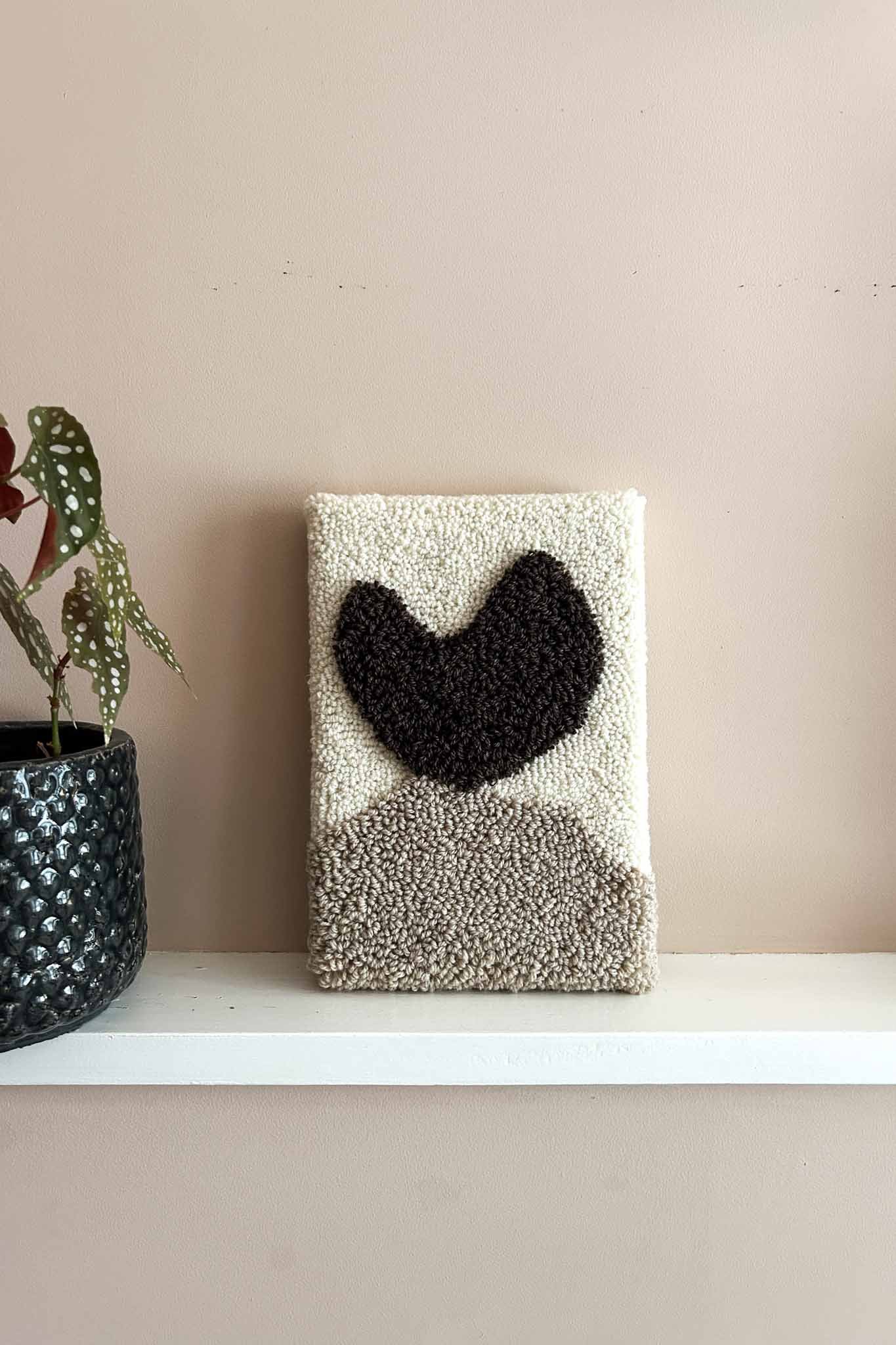
When I started my own practice, I wanted to see how close to home I could source my materials. I discovered a small farm a few miles away in the Kent marshes that produces undyed yarn from their own sheep. The limited palette of browns, greys, and creams really appeals to me. It allows texture, form, and light to do more of the work.
Using natural fibres is essential for me. Many people working with punch needle use synthetic yarn because of cost, but the sheen and feel never felt right to me. I want the material to feel honest, grounded, and considered, while still bringing a contemporary sensibility to the work.
Could you walk us through your creative process when working with punch needle? What part of the making feels most essential for you?
The process begins with something that catches my attention. It might be a shape, a shadow, a ceramic vessel, or an exhibition. I spend a lot of time researching, reading, listening to podcasts, and looking at artists from different periods. At the moment, I’ve been particularly drawn to surrealism and experimenting with its techniques in a playful way, without the pressure of producing a finished piece.
From there, I start working with collage or paint, exploring composition. I then move into Illustrator, which allows me to quickly shift forms and colours and see how everything sits together. Colour choice is very important to me, as even subtle changes can completely alter the feeling of a piece.
Once the design feels resolved, I stretch the monks cloth onto a large frame and draw the design freehand. The punching itself is the longest stage. Larger works can take weeks or even months, and it can be physically demanding. Standing for long periods, reaching up or crouching down, really affects the body. Smaller works are gentler and can be worked on in the lap.
When the piece is complete, I trim and sculpt the surface with scissors, refining edges and enhancing the differences in pile height. This helps clarify the forms and brings out how the work interacts with light throughout the day. Finally, the piece is either stretched and framed or set into a custom wooden frame.
Punch needle is often described as meditative and grounding. How does the physical act of working with yarn and texture affect your well being?
The repetitive nature of the process does bring me into the present moment. When I’m working, I’m not thinking about everything else I need to do. That focus is grounding. At the same time, large pieces require a lot of patience, especially when filling in big areas of a single colour.
I usually listen to audiobooks or music while I work, and over time that has become an important part of the rhythm. It allows me to absorb stories and ideas while my hands are busy, which feels nourishing in its own way.
Through your workshops, you open the practice to a wider community. What role do workshops play in sustaining handmade craft today?
Workshops remove a lot of the barriers people feel around making. Once the materials and tools are provided, people realise how accessible it is to create something with their hands. Punch needle is especially forgiving. If something feels wrong, yarn can be pulled out and reworked. Mistakes are rarely final.
I often say that threading the needle is the hardest part. Beyond that, anyone can do it. In just a couple of hours, participants leave with a finished piece, which creates a sense of pride and connection to the process.
Workshops also create space for shared experience. Whether they are public or corporate sessions, people sit together, slow down, and talk. That sense of community, of being present with others while making, feels like an important part of keeping craft practices alive.
Are there any new projects or directions you are currently exploring?
I’m currently working towards a textile focused exhibition with a gallery in Norwich. It will be my first show dedicated entirely to textile artists, which feels meaningful to me. I’m interested in helping elevate textiles as an art form, rather than something confined to domestic or decorative contexts.
Alongside that, I’ve been exploring the back of the punch needle work. Traditionally, the textured side is presented as the front, but I find the reverse incredibly beautiful. The way the yarn lies, the gaps, the imperfections, and how light moves across the surface all feel very alive.
I’ve started presenting that side as the front in some pieces, creating a surface that feels tighter and more like a tapestry than a rug. It’s a quieter expression, but one that I find deeply compelling.
Where can people engage more with your work and workshops?
My work can be seen through exhibitions, private commissions, and online. I share new pieces, process, and upcoming projects on (@alice_liptrot_) and my website (www.aliceliptrot.com). While I’ve slowed down public workshops locally, I continue to run private and corporate workshops, mainly in London.
They remain an important part of my practice, offering a way to share the technique and create moments of connection through making.
All photos belong to Alice.